
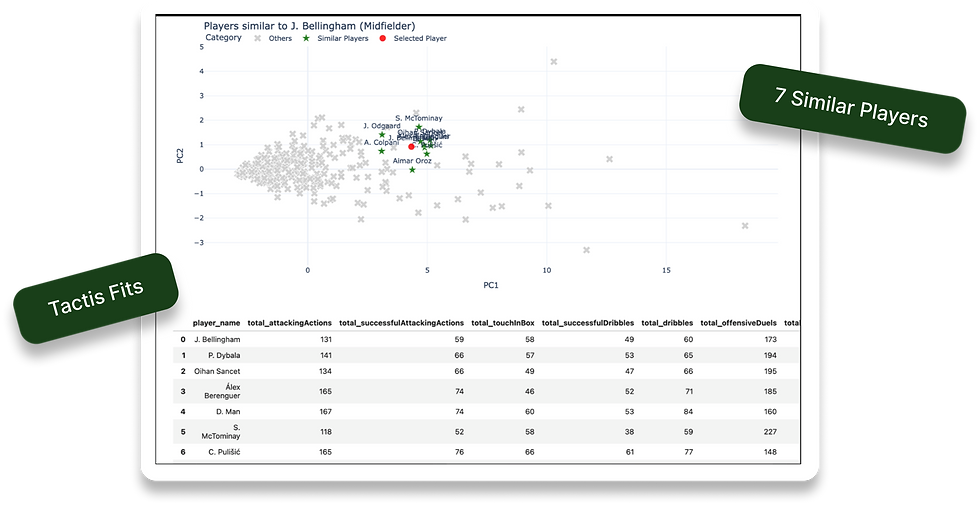
Main Objetive
To identify players with similar profiles across leagues, roles, and styles.
By combining contextual ELO, match behavior, and performance metrics, this algorithm helps scouts, analysts, and clubs find the closest-performing players — regardless of league, nationality, or exposure. It’s not about fame — it’s about fit.
The problem
The Old Way
MANUAL INTUITION-BASED COMPARISONS
HARD TO HANDLE LARGE DATASETS ACROSS MARKETS
STATIC STATS WITHOUT CONTEXT OR TACTICAL ALIGNMENT
NO LINK TO ECONOMIC OR CONTRACT VARIABLES
SLOW AND LIMITED REPRODUCIBILITY
The New Way
DATA-DRIVEN PLAYER SIMILARITY MODELING
SCALABLE FILTERS REDUCE COMPLEXITY AND NOISE
TACTICAL-AWARE SCORES BY ROLE AND FIT
DYNAMIC FILTERS FOR AGE VALUE MINUTES SALARY CONTRACT
AUTOMATED EXPORTABLE LISTS WITH RANKING AND DISTANCE
Technical Description
Vectorization of Players
Each player ppp is represented by a normalized feature vector xp∈Rnx_p \in \mathbb{R}^nxp∈Rn, including performance, physical, and contractual metrics.
Distance Calculation
Compute similarity using Euclidean or cosine distance.
Filtering & Weighting
Apply age, league, market value, and minutes played filters. Optional weights adjust importance of attributes (e.g., passing vs. speed).
Top-k Retrieval & Ranking
Return Nk(p)N_k(p)Nk(p) = k most similar players with their distance scores and export results for scouting or visual dashboards.
Details:
Let d:ℝⁿℝⁿℝ0 be the selected distance metric (e.g., Euclidean, cosine), and let kkk be the number of nearest neighbors to retrieve. The algorithm returns the set:
Nk(p) = {q ∈ P \ {p} : d(xp,xq) d(k)}
where d(k) represents the k-th smallest distance in the set
{d(xp,xq) : q ∈ P \ {p} }.
The procedure includes normalization of each dimension of the vector xp based on the scale and distribution of attributes, an optional weighting step using a predefined weight vector, and a dynamic filtering of the set P according to criteria such as age, league, or market value.
The algorithm then returns an ordered list of players {q1,q2,… ,qk} with their corresponding distances {d1,d2,… ,dk} to the reference player.


Winning is the first sports tech company to build a modular solver system for decision-making in football, powered by AI, game theory, and optimization.
Other Objetives

Customize
Allow customization of search criteria based on each club’s specific priorities.
Club-Style
Personal
Seamless Integration
Enable integration with scouting systems through exportable results and compatible formats.
Compatible
Streamlined

Precision Scouting
Include advanced filters (league, nationality, market value, age) for precise segmentation.
Targeted
Granular
Optimize
Optimize analysis time by reducing the need for manual player review.